
County Permit Drawings Logo

What Floor Joists Actually Do (and Why Span & Spacing Matter)

Floor joists are the backbone of any wood floor system. They support loads, tie the structure together, and determine how solid a floor feels. Proper sizing, spacing, and detailing not only ensure safety but also improve comfort, reduce bounce, and prevent costly callbacks.

September 11, 2025
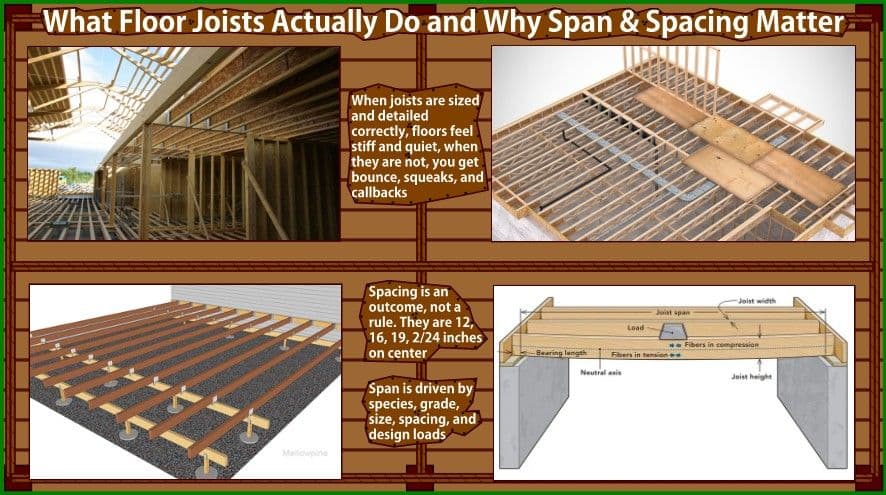
What Floor Joists Actually Do

Why floor joists matter

Floor joists are the primary horizontal framing members in a wood floor system. They collect live loads (people, furniture) and dead loads (materials) and deliver them into beams, walls, and the foundation. When joists are sized and detailed correctly, floors feel stiff and quiet; when they’re not, you get bounce, squeaks, and callbacks.

Span, spacing, and material

  • Span is driven by species, grade, size, spacing, and design loads.
  • Spacing (e.g., 12/16/19.2/24 in. o.c.) is an outcome, not a rule.
  • Material choice matters: solid-sawn works well for short spans; engineered I-joists help achieve longer, flatter floors (follow the manufacturer’s hole/bearing rules).

Deflection and vibration

Even when “strong enough,” a floor can still feel bouncy. Serviceability (deflection and vibration) determines perceived stiffness. Using appropriate deflection targets and continuous glue-and-fasten subflooring dramatically improves performance.

Detailing essentials

  • Subflooring: correct thickness; glue + fastener schedule.
  • Blocking/bridging: reduces roll and helps distribute loads.
  • Rim joists: tie the ends; keep nailing continuous.
  • Holes/notches: only where allowed; follow code or manufacturer charts.
  • MEP coordination: plan duct/plumbing paths so you’re not forced into bad cuts on site.

Quick checklist (permit-ready framing)

  • Span/spacing verified from official tables or manufacturer literature
  • Subfloor adhesive + fastener schedule noted on plans
  • Hole/notch limitations detailed; MEP routes coordinated
  • Bearing lengths, hangers, and connectors specified
  • Fireblocking/insulation callouts where required

Enjoyed this article?

Subscribe to our newsletter to get more insights about architecture, engineering, and technology.